Process & ideas
The vertical line
Across two graduating projects, the work circles a single motif: the line — and, most of all, the vertical line — as the axis that holds a composition together and points beyond it.
An imaginary geography
Introduction
A world that depends on light
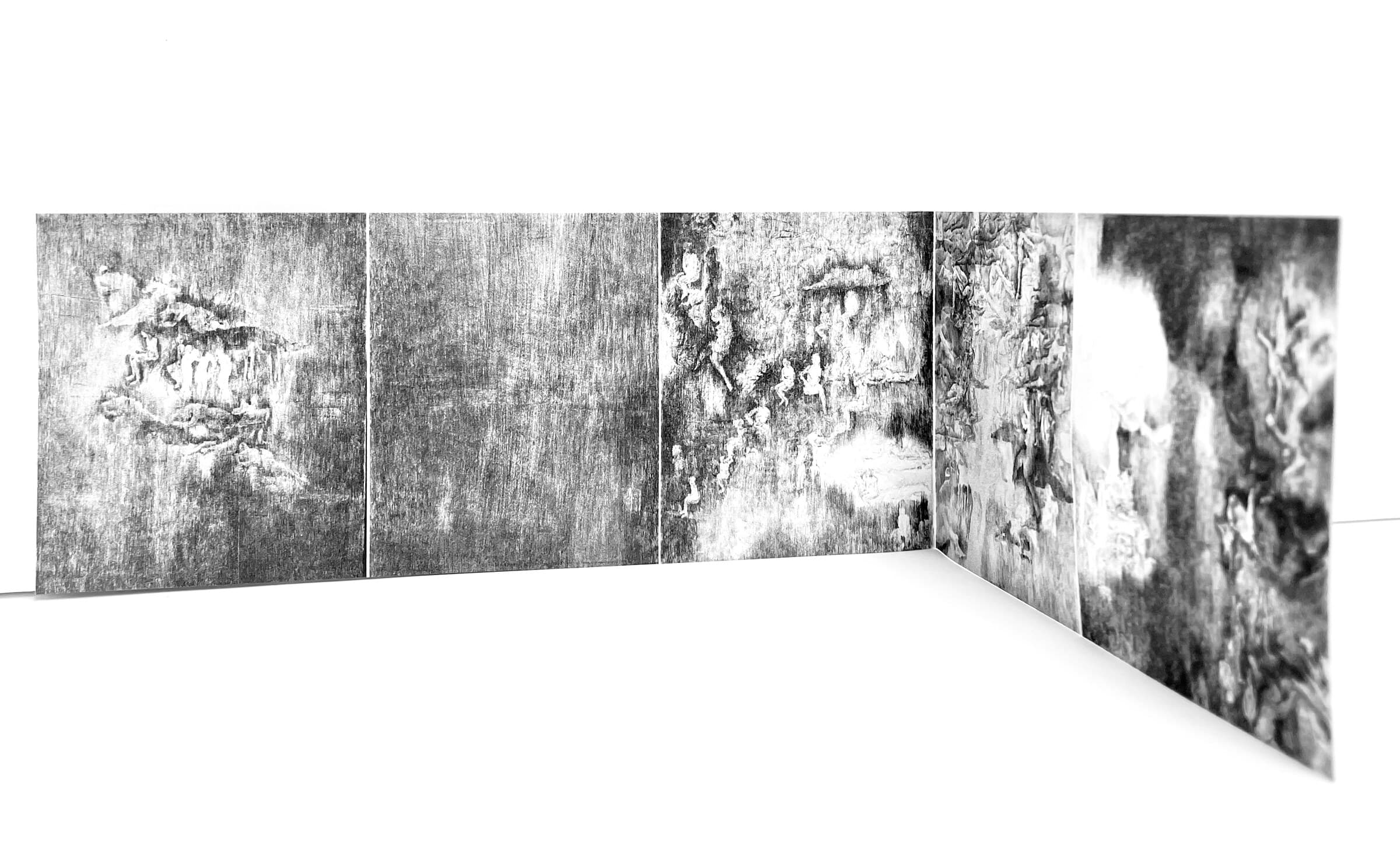
“Maps” is a deep exploration of an imaginary geography, manifested through a drawing made entirely in graphite. The foundation of the composition is the vertical line — not merely a structural element, but a symbol of equilibrium and of the connection between the material and the immaterial worlds. The title evokes a world that gravitates around light, suggesting an intrinsic dependence on it, and a mapping of a psychological and emotional geography.
Each form drawn is a meditation frozen in time — a symbol of perennial reflection.
Concept
Imaginary geography
Imaginary geography explores spaces that do not exist in physical reality, created and lived subjectively through art. At the intersection of the concrete and the conceptual, it articulates inner states, memories and psychological conditions. The graphite drawing maps these mental spaces through essentialised forms and lines. Each line and form becomes a representation of psychological territories, inaccessible in any conventional way — an approach shaped by Michel Foucault's notion of “heterotopias,” real spaces that function in an alternative dimension.
Central motif
The relevance of the vertical line
The vertical line carries a profound significance, evoking ideas of stability and the connection between earth and sky. In pre-modern art it suggests spirituality and transcendence — as in Gothic architecture. Here it functions as a stable point of reference, an axis around which the drawn forms are articulated and organised. As a static element, verticality represents “frozen” time: states and meditations that stagnate, captured in a unique moment of creation. The vertical line is not merely a graphic device but a symbol of continuity and of the link between the inner and outer worlds.
Technique
Graphite, and gradual simplification
Drawing in graphite is one of the purest and most expressive ways to create an image, offering precise control over line and texture. Graphite, with its soft and malleable texture, allows a wide range of expression, from fine, delicate lines to intense, saturated tones. The simplification of form is a central pillar: a process of distillation, not mere reduction, in which each element is analysed and kept only if it serves a precise function. Complex forms are reduced to the essential lines that suggest movement, direction or tension, without compromising the work's visual integrity.
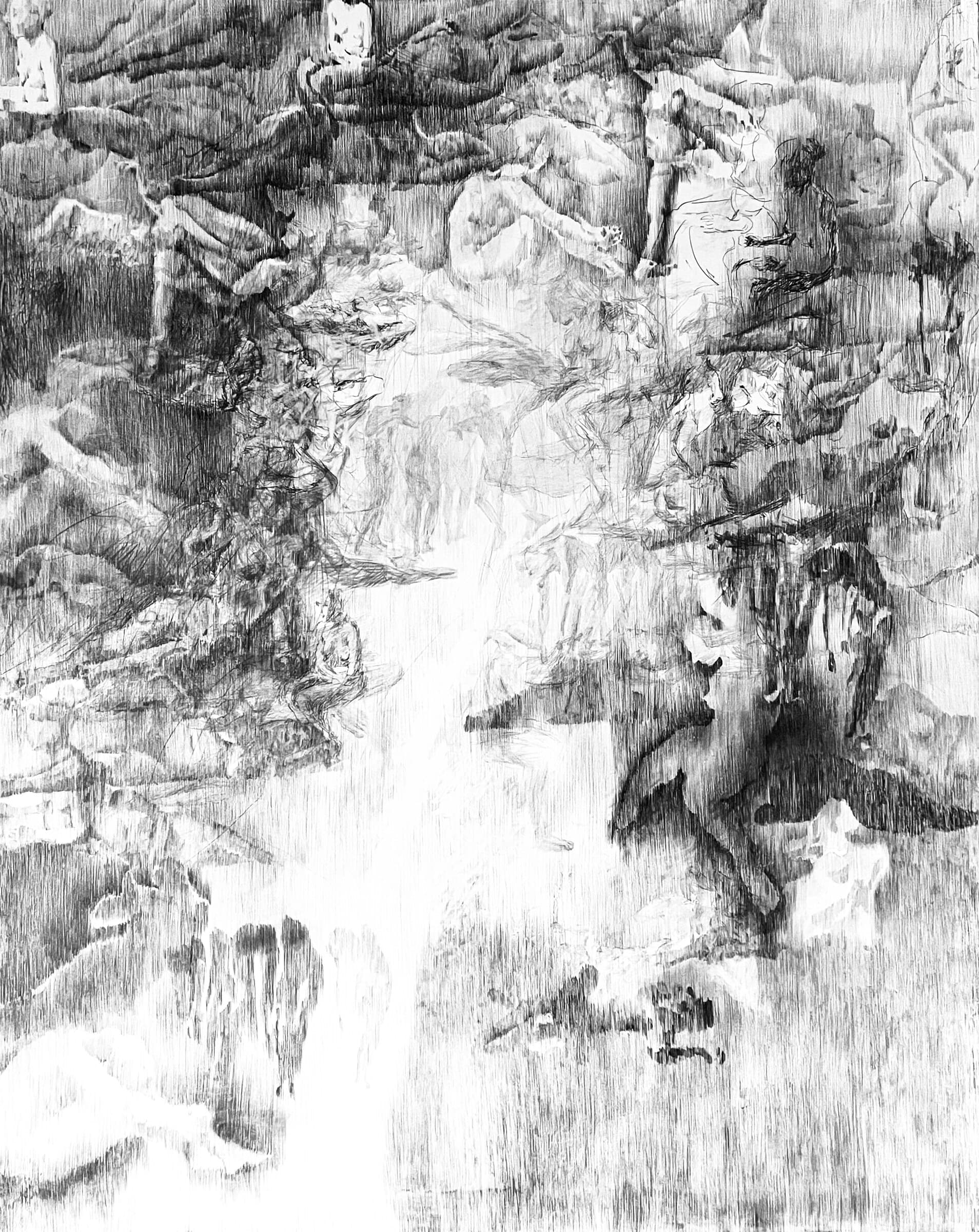
Maps XXII · Graphite on paper · 2024
Reading
Meditation as ground
Meditation, in the artistic sense, is a state of deep contemplation — an attempt to sound the depths of consciousness. In this work, meditation is not only a theme but an essential method of creation, a process through which images form and develop as thoughts and emotions are distilled into visual expression. The work captures moments of introspection in which time seems to stop, allowing a profound exploration of the self — a subjective, inner time that flows at the rhythm of one's own reflection.
An absent memory — fragments that, though not consciously accessible, keep shaping perception and the creative act.
Drawing is a thing of the mind
Premise
Drawing as a thing of the mind
“Painting is a thing of the mind” — and so, too, is drawing. Drawing was chosen as the primary medium of expression precisely because it is a thing of the mind. Whether made in graphite, lead, silverpoint or natural or compressed charcoal, the drawing represents the human body in its many states, making it the principal subject.
“Lines hold a power of evocation capable of reopening the path of the soul.”
Conflict
Ingres and Delacroix
The work returns to the 19th-century quarrel between Ingres and Delacroix. For Ingres, to know how to draw is to know and execute to perfection a system of recognised forms. For Delacroix, it means endowing the line with an electricity that runs through it and, by induction, awakens an analogous echo in the one who contemplates it — to depart, by definition, from a conventional type the classicist considered perfected.
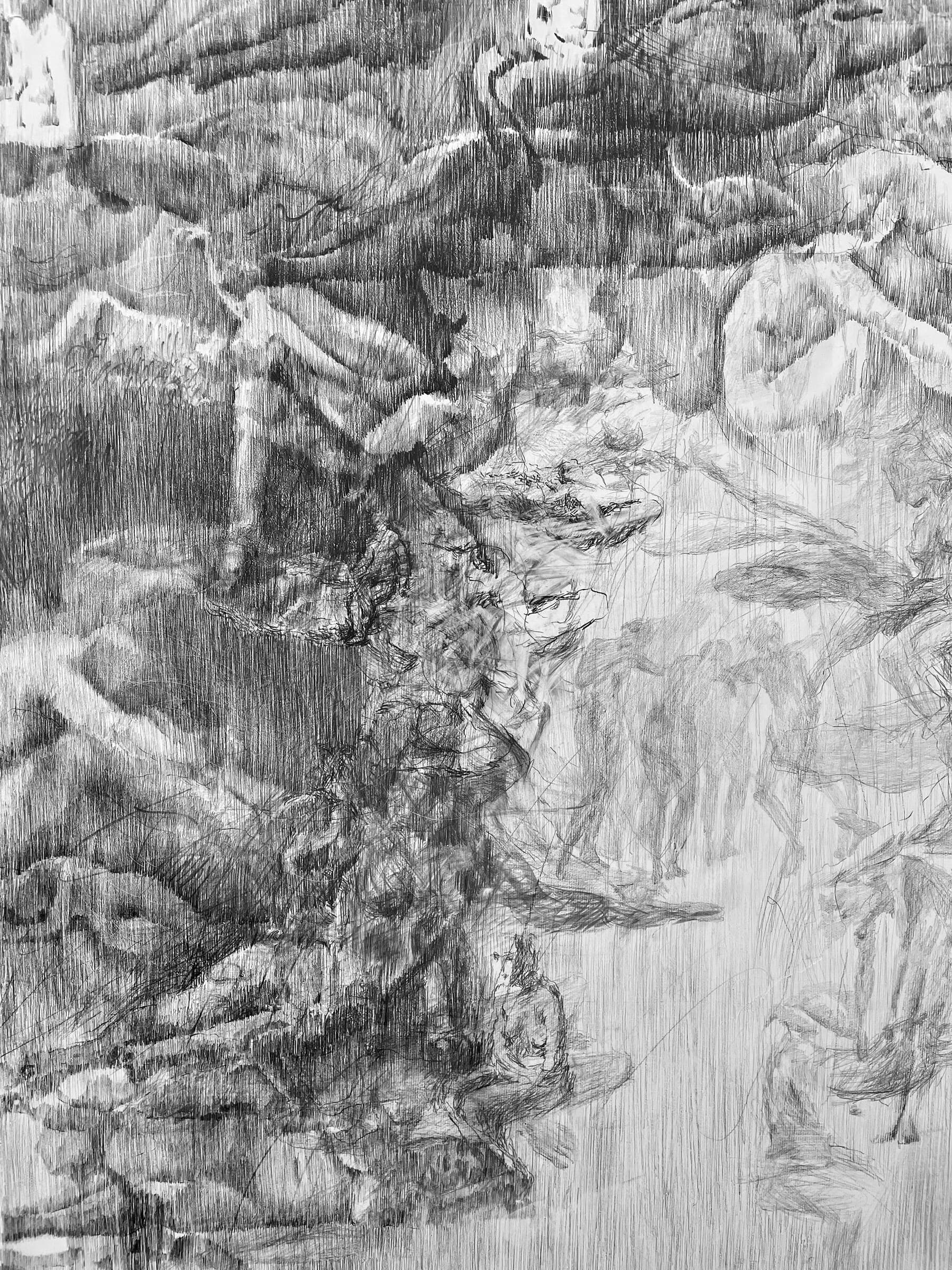
Untitled VI · Graphite on canvas · 2023
Light & image
The role of the image
From the moment the image takes shape, the artist explores it, analyses it and weighs the possibilities of working with it, shaping it accordingly. With experience and intelligence, images drawn from the outer world or from our obscure depths become the material offered for its development — without ever losing contact with the primordial impulse that generated it. Goethe teaches that the eye's sensations are only passing signs; it is up to us to transform them into a meditation upon the world and upon our own being.
Working method
Drawing as concept
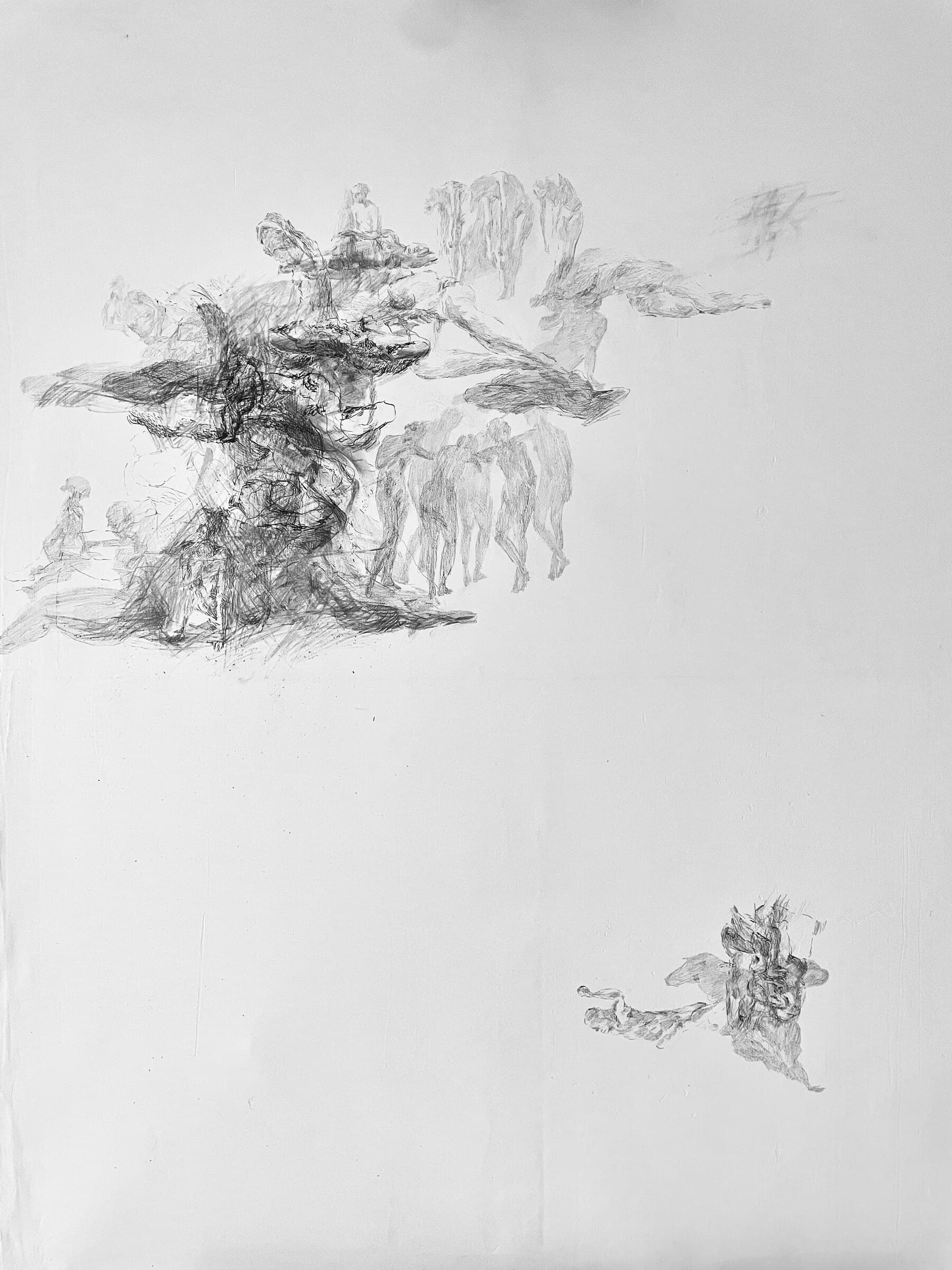
This conceptual practice uses drawing as its principal mechanism for approaching the figurative. The concept is built around several human figures as the central element. In a general composition conceived in juxtaposed and combined registers, the drawing unfolds spontaneously, revealing without disguise the true sense of the search that guides the artist. Executed exclusively from line and modelling — a modelling so apt to mimic relief — it is gradually elided, until only a luminous silhouette remains, evident in a distinct linear contour upon a dark ground.
Conclusion
Through accumulation and repetition
Through accumulation and repetition, the works (re)construct, (re)define and reflect upon the different processes of creating and structuring information — the human body — with a return to the inner universe. The palette is a reduced one, of value-tones between black and white, with the intention of drawing the viewer closer to the subject. The eye must travel and follow a line in order to know it; through movement, we retrace the path the creating mind has recorded.
People become databases — sums of the sketches and the making of these years.